Concepts
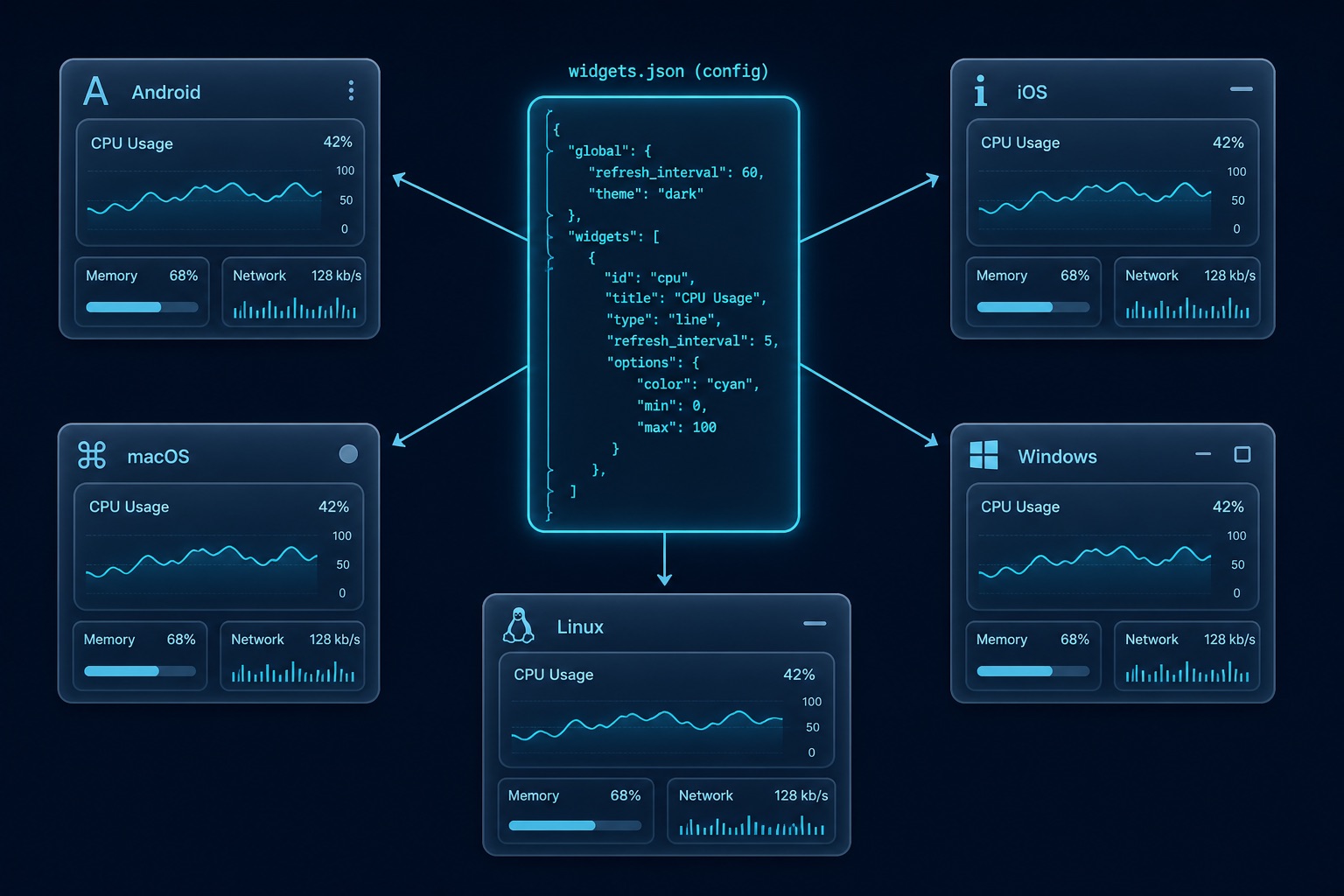
Architecture flowchart
End-to-end data path: one IR write on the host, five possible render surfaces.
flowchart TB
  subgraph App["Your app"]
    JS["JS / TS<br/>tauri-plugin-widgets-api"]
    RS["Rust host code<br/>optional"]
  end

  subgraph Host["Plugin host (Rust)"]
    CMD["Commands<br/>setWidgetConfig · setItems<br/>createWidgetWindow · …"]
    APPLY["Apply / validate<br/>capability warnings"]
    STORE["Shared store<br/>config:{widgetId}<br/>pending_actions · nonce"]
    AC["Adaptive Cards<br/>transpile + optional rasterize"]
    PROTO["widgetview protocol<br/>embedded widget.html"]
  end

  subgraph Surfaces["Native / desktop surfaces"]
    AND["Android<br/>Jetpack Glance"]
    IOS["iOS WidgetKit"]
    MAC["macOS WidgetKit"]
    WIN["Windows Widgets Board<br/>C# IWidgetProvider"]
    DESK["Desktop webview<br/>macOS · Windows · Linux"]
  end

  JS --> CMD
  RS --> CMD
  CMD --> APPLY --> STORE
  APPLY --> AC
  CMD --> PROTO

  STORE --> AND
  STORE --> IOS
  STORE --> MAC
  STORE --> DESK
  AC --> WIN
  PROTO --> DESK

  AND -.->|actions / receipts| CMD
  IOS -.->|actions / receipts| CMD
  MAC -.->|actions / receipts| CMD
  WIN -.->|actions / receipts| CMD
  DESK -.->|actions / receipts| CMD
Write path: setWidgetConfig → validate → write config:{widgetId} (+ Apple transport / Android prefs / desktop file) → reload or pin update → renderer paints IR.
Desktop shortcut: createWidgetWindow without url loads the embedded page over widgetview; that page calls getWidgetConfig itself — you do not copy widget.html.
Windows Board: same IR write also fills ac:template:{widgetId} / ac:data:{widgetId} for the MSIX provider.
Actions (tap → app):
sequenceDiagram
  participant Surface as Widget surface
  participant Store as Shared store
  participant Host as Plugin host
  participant App as Your app

  Surface->>Store: enqueue pending_actions
  Surface->>Host: optional receipt
  App->>Host: onWidgetAction / pollPendingWidgetActions
  Host->>Store: drain pending_actions
  Host->>App: { action, payload, widgetId, group, ts }
Apple host writes use one configured transport — see Transport. Platform setup: Choose a platform.
Intermediate representation (IR)
The IR source of truth is Rust (src/models.rs). TypeScript types are generated (pnpm codegen). Every platform renderer consumes the same JSON tree.
A config holds up to three size families:
interface WidgetConfig {
  version?: number;
  small?: WidgetElement;
  medium?: WidgetElement;
  large?: WidgetElement;
}
group and widgetId
group— shared storage namespace (App Group on Apple, SharedPreferences name on Android, file namespace on desktop).widgetId— logical identity of one widget UI inside that group. Required onsetWidgetConfig/getWidgetConfig/startWidgetUpdater.
Storage keys look like config:{widgetId}. Multiple widgets can share a group and show different configs.
Platform gotchas:
- Apple:
groupmust equalplugins.widgets.appGroupand the Xcode App Group. SwiftTauriWidgetProvider(widgetId:)defaults to"default"— keep it equal to the JSwidgetId. - Android: default store name is the app package name (not an arbitrary
group.com…string) unless you settauri_widget_groupmeta-data. See Android setup. - Desktop webview: any stable string works for the embedded window; still set
plugins.widgetswhen developing on a macOS host.
On Android, each home-screen instance maps to a logical widgetId (meta widgetId:{appWidgetId}). Call setWidgetConfig per id after pinning.
Desktop renderer (widget.html)
On desktop, the default UI is not a file you add to the Vite/Webpack root. The plugin embeds widget.html in the Rust crate and serves it via a custom URI scheme when you call createWidgetWindow without url. Install the crate/JS package, push a config, open a window — nothing else to fetch. Optional custom pages and tauri.conf.json caveats: Desktop webview.
Transport (Apple)
The host writes through one configured driver (plugins.widgets.transport). Wrong transport fails plugin init loudly — empty widgets from a silent fallback are not expected. Details: Transport.
Diagnostics and receipts
Native renderers can report receipts. Use getWidgetDiagnostics(group) to inspect what the extension last rendered / skipped. Receipts feed diagnostics — they do not select transport.
Capability warnings
When a config changes, the plugin logs degraded / unsupported capability warnings for the current platform only. The full matrix is in Core vs extended.
Breaking changes in 0.4
widgetIdrequired on config / updater / built-in window renderer- Storage keys renamed:
config:{widgetId},pending_actions - Action payload includes
widgetIdandgroup - iOS
groupmust start withgroup.(no silent rewrite)